

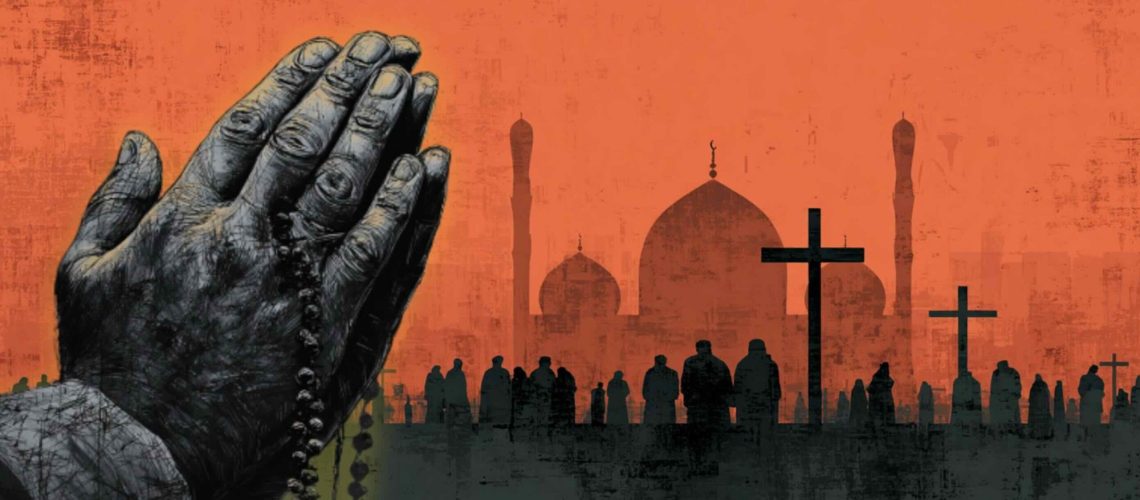

Islam Is Terrorism, and Christianity Must Launch a New Crusade?
For decades, this has been the story that has been echoed and repeated across Western media, and over time, it appears that it has achieved its goal and has hardened into an unquestionable truth.
Initially, the ideal of a dichotomy defining Christianity as this superior ‘civilised’ faith, in opposition to the ‘heretic’ Islamic faith of ‘terrorism’ which does not tolerate the ‘other’, was founded on Eurocentric notions of identity aimed at othering a world that was, in fact, more advanced in its structure and wealthier in its social fabric and resources than Europe and the modern-day ‘West’. This world was, and remains, the Arab world; the very world where Christ lived, preached, and delivered the ultimate miracle of sacrifice and resurrection in service of humanity and of the oppressed.
This view had even framed the Crusades in an oversimplified manner as a religious ‘clash of civilisations’ between Christianity and Islam, something that is being capitalised on in our media today.
The argument was put forward in a past era by Samuel Huntington in The Clash of Civilizations and the Remaking of World Order, which aimed to entrench a Eurocentric and Orientalist perception of the East and Arabs.
Still, the truth is much more complex, and that vision distorts not only history, but also disregards accounts of local Arab Christians who lived in the region at the time.
Similarly, today, the notion of a ‘modern’ and ‘democratic’ Christian West that is at war with a ‘backward Islamic world’ that oppresses women and is ‘threatening’ Christian ‘values’ and continuity in West Asia is a story that Hollywood has rehearsed in hundreds and thousands of movies and TV series for decades.
Painting terrorists as ‘barbaric Muslims’, ‘faceless immigrants’, or any conveniently ‘othered’ group, this script is not only about manufacturing consent for foreign intervention, but also for a more significant goal: entrenching the idea that the war against Arabs must be fought abroad before it threatens the West at home.
The same script appears in political discourse, amid an evident rise in Christian nationalism, which has little to do with Christianity and much to do with reviving a white supremacist ideology using the pretence that a ‘White Christian West’ is superior to all else.
Take, for example, Tommy Robinson making claims on a Zionist-funded trip to Occupied Palestine, known as ‘Israel’, responding to the Arab award-winning journalist Hala Jaber, who debunked his ‘Christian Zionist’ claims that Hamas would ‘kill’ the Muslim family who had protected the Church of the Holy Sepulchre and held its keys for centuries. According to a history-ignorant Robinson, ‘the wrong type of Muslims’ was ignoring the fact that Hamas has historically protected churches in Gaza which Israel has bombed.
A Threat To Europeans at Home (in Europe) and Arabs at Home (Arab Countries)
This notion not only threatens Europe itself but also weaponises the tragedies of people who have paid the price of foreign domination deployed through colonisation, imperial expansion, capitalist exploitation, and direct military occupation.
After World War II, Europe and the West secured their access to vital resources by establishing compliant client states such as the Gulf monarchies, Lebanon, and Jordan, ensuring a steady flow of oil and geopolitical leverage.
Yet other states, like Iraq and Syria, proved far less sustainable under such control. Iraq remains to a large degree under Western influence, although it has been weakened since 2003. Syria was not particularly occupation-friendly, which led to the Battle of Maysaloun in 1920, against the French and their allies.
And then, despite the French mandate, which failed to consolidate influence, Syria remained the heart of the Arab world’s dignity and wisdom.
Let me explain with this small retell of a significant incident no history book will tell you about:
In the spring of 1945, as the newly formed United Nations convened in San Francisco, delegates flaunting their colonial privilege spoke in French and English, drawing lines in the sand as they designed the post-war world order. Then came a Syrian representative who refused to bow.
Syria’s Prime Minister at the time, Fares al-Khoury, a man who rose from a small village to make the voice of an independent Syria heard, walked deliberately to the seat of the French delegate and sat down. The hall froze. Moments later, the French ambassador approached, demanding he vacate the chair.
Al-Khoury looked up and replied calmly: “You are outraged that I sat in your chair for five minutes. Imagine how Syrians felt after 25 years of your occupation”.
In Syria, until the US, UK, and the Zionist bloc succeeded in regime change in December 2024, Arab resistance was entrenched as a government policy. Through that policy, resistance movements were not just protected but welcomed, trained, armed, and offered the space to consolidate their identity as enemies of imperialists and occupiers.
The West was most threatened by the idea that some Arabs would be willing to fight and sacrifice their lives to seize freedom because, in doing so, they would slowly diminish the sphere of influence of the occupiers and, with time, reclaim their right to their resources, stripping the imperialists of their illegitimate gains.
And with the Iranian Revolution in 1979, the West lost one of its most strategic pillars in the region: the Shah’s dictatorship in Iran. This, in turn, created a ripple effect, giving resistance movements in the region greater momentum as they rediscovered, not just their identity, but their faith.
Under Imam Khomeini, Islam transitioned from being confined to symbolic ritual into a living, active understanding of the message of Prophet Mohammed (PBUH), his son Imam Ali, and his grandsons Imam Hasan and Imam Hussein. It was a message rooted in refusing submission to falsehood for the sake of self-preservation, and in upholding dignity and truth above all. It is a message that deeply resonates with genuine Christianity.
From that point on, reclaiming influence over these areas became a central Western objective, not only to reassert dominance and secure exploits, but to suppress any model of independence that could liberate West Asia from US and UK-led hegemony.
For Europe, such a shift would mean the loss of access to the very resources and stability on which its prosperity still depends. The push for liberation at the time was not just bound to Muslims. Christians were part of that regional resistance, from former Syrian PM Fares al-Khoury to Archbishop Hilarion Capucci, who dedicated his life to the Palestinian cause.
Why does this matter? Because an Islam capable of breaking the West’s sphere of influence became the ultimate enemy. To fight it, the West chose not a Crusade, at least not openly, but infiltration. Through client regimes, payroll sheikhs, and compliant priests, the West sought to subvert religion against itself, creating an agenda-driven Islam and promoting the false narrative of ‘saving Christians in the Middle East’.
But this meant facing a legacy of Arab resistance rooted in real and public positions taken by inspirational people in the region’s history. The client states (Gulf states, Jordan, and eventually Egypt) were compliant; the enemy of the Imperialist bloc, was resistance. Another excerpt from history to show that this legacy is not against Muslims, but also Christians, is when al-Khoury was confronted with this ‘white saviour of Arab Christianity’ narrative, and he responded by saying:
“If France claims it occupied Syria to protect us Christians from the Muslims, then I, as a Christian, ask for protection from my own Syrian people”, and moved on to proclaim, from the Ummayad mosque’s pulpit “La Ilaha Illa Allah [There’s no god but God]”.
This was a Christian reciting prayer from a Sunni Muslim Mosque.
Meanwhile, the West continues to present itself as the embodiment of ‘human values’, even while supporting genocides and massacres across the world. Its goal remains the same: to mobilise populations under any banner that can reshape and fragment Arab identity by reducing it to the colonial term ‘Middle East’. This, in itself, is a term rooted in British geographical and imperial perspective. All this serves one purpose: to sustain its flow of resources and wealth, and to shield Europe and the West from the consequences of their inevitable economic crises.
The more accurate term, from the perspective of the author, an Arab Christian, seeking to restore the Arab world to its rightful identity as part of a broader Islamic world, and within its true geolocation, is West Asia, the western part of the Asian continent that has long borne the intertwined burdens of faith and colonisation.
But, let’s be clear, this is not a defence of Islam. Islam does not need a Christian to defend its honour. Muslims themselves have long stood against Western proxies that tried to tarnish their name and exploit an externally engineered sectarian division in the region.
This is an explanation for those misled by exploitative narratives who are kept from seeing the truth by the constant simplification of events that are deeply political. It is also a testimony from an Arab Christian honouring the sacrifices of Muslims who have not only defended the Arab and Islamic worlds, and continue to do so, but who have also protected the very existence of Arab Christians in this region — while the Imperialist alliance has worked to create the conditions that would cause a catastrophic exodus of Christians from the region.
Western media’s fixation on sectarian narratives is not accidental. It is a deliberate strategy meant to divide societies, distort the region’s image, and weaken the unity that once stood firm between Muslims and Christians. Its aim is to make sure that the unified identity of Arabs as a whole is not written or spoken about to Western audiences.
Yet on the ground, unity overcame these challenges — from Iraq to Syria, Lebanon, and Palestine. Every headline that speaks of ‘religious violence’ without context serves one goal: to frame neocolonialist domination as a moral crusade while othering the peoples they claim to protect.
It is a construct designed to justify occupation, sanctions, and proxy wars, all hidden behind the language of “civilisation,” “Democracy,” and “saving minorities.” It is a manoeuvre to manufacture consent by the rapacious Western alliance.
Exploiting Sectarianism to Infiltrate and Occupy
Sectarianism thrives on division: between Sunni and Shia, Muslim and Christian, Arab and Persian — categories that collapse whenever people on the ground unite against the same foreign hand shaping their fate.
In Iraq, when ISIS swept across Mosul and the Nineveh Plains in 2014, massacring civilians and destroying churches, it was the Popular Mobilization Forces (PMF), an alliance of Iraqi fighters from every sect, who rose to confront them. Among them were Shia units, Christian brigades like the Babylon Brigade, and tribal volunteers.
They fought side by side to reclaim Iraq, including the Christian villages, rebuild churches, and restore coexistence.
What Western observers called ‘Shia militias’ were in fact Iraqis defending their land from an organisation grown out of foreign funding and occupation.
In Syria, the Syrian Arab Army, comprising Shia, Sunnis, Alawites, Christians, Druze, and even Kurds, fought not for their sect but for the survival of an inclusive sovereign nation. During the 2013/14 siege of Al-Kindi Hospital in Aleppo, soldiers from every background endured hunger and bombardment together.
Local accounts tell of Christian soldiers sharing their food with fasting Muslim comrades as so-called ‘rebels’, armed and coordinated by Western governments, closed in.
At that time, these terrorists were celebrated in Western headlines as ‘the Syrian people’. When their name changed to Jabhat al-Nusra (Al Qaeda in Syria), they were shown as ‘moderate rebels’ when needed and as enemies of Christianity when needed, depending on the region and narrative.
In Lebanon, the Lebanese Forces, a US-allied party, proclaimed support for the Western-backed Syrian Muslim Brotherhood (Free Syrian Army), which openly threatened Christians, especially in places like the Valley of Christians (Homs), and Al Sqeilbiyyeh, an Orthodox Christian town in northern Hama. Simultaneously, Western media framed the ethnic cleansing Takfiri brigades as ‘freedom fighters’ in order to maintain the narratives that would ultimately topple the Syrian Government.
Eventually, Nusra Front were rebranded as HTS to distance them from the savagery of the Syrian Al Qaeda. This was also in preparation for bringing them to power as the newest addition to the regional client states.
Among the soldiers who became symbols of this shared struggle was Ibrahim al-Hallak, a Sunni Muslim from Aleppo who, in the middle of battle, looked into the camera and said, “Wallah l-namḥīha” (“By God, we will erase it”). He was speaking of ISIS and the imported extremism fragmenting his country.
His words became a national cry: a Sunni soldier fighting beside Alawite, Shia, Christian, and Druze comrades against terrorism imposed from abroad. He was later martyred, but his words outlived him.