


Part 1: An Innocent Abroad?
In summer 2022, Kit Klarenberg and I exposed in The Grayzone how Emma Briant — self-styled “disinformation expert” and “maven of persuasion” — had conspired with journalist Paul Mason, under the tutelage of Andy Pryce, a career MI6 officer, to discredit and deplatform left-wing, anti-war academics, activists, and journalists.
This article digs deeper and looks closely at the various activities in which she engaged which ended up placing her into intelligence connected networks. It analyses the way in which academics such as Briant can get drawn into collaboration with shadowy intelligence figures, perhaps without fully realising what is going on. I put it this way to give Dr Briant the benefit of the doubt at the start of this article. But readers will no doubt come to their own conclusions as we traverse her career and her varying and increasingly close contacts with the national security apparatus in the UK, US, and NATO.
Emma Briant poses as a leftish critic of state and corporate agendas. Here she is on a recent panel in April 2025 at the University of Cambridge, which she organised on threats faced by academics.
Amongst other things, she says the following:
It’s a testament to the power of research colleagues work that some of … them find themselves singled out for a barrage of abuse and attempts to silence them. Beyond the more specific challenges faced by researchers challenging powerful or deceptive actors, we are witnessing an increasingly hostile environment for scientific inquiry of all kinds. Attacks on the university itself, for example, are happening in the United States …
In contrast to the many conspiracy influencers that are crying ‘censorship’ across social media to millions of followers, academics often feel unsafe and unable to speak out about threats that they may face publicly … They feel very often that more attacks will follow if they raise the alarm. Now that means a lot of people end up fighting this battle alone, and we want to make sure that that doesn’t happen, which is why this organizing this panel was so incredibly important to me.
The threats that we see are not just a feature of the US political environment, though. They are experienced already in the United Kingdom and across Europe and around the world …
Threats may be complex, relentless, and lack solutions, which is why we’re talking about them today, because we need to provide solutions for the many, many researchers to enable their work around the world.
Much of the media focus in recent years has focused on attacks on researchers discussing them as though they were a feature of the social media environment alone leading many to the assumption that researchers are complaining about nasty comments on the internet that they’re being oversensitive to legitimate criticisms. What we’re talking about isn’t that. What we’re talking about here are coordinated multi-vector attacks from often well-funded political actors or governments.
This sounds quite anti-authoritarian, vaguely left-wing, and certainly liberal. It is notably non-specific about the origins of these attacks, though it is pretty clear that Briant means to include in those attacks legitimate reporting about the role of ‘disinformation’ researchers in intelligence networks, as was done in The Grayzone pieces I mentioned at the beginning, and indeed as is done in this article.
As if to emphasise that point, we can report that the opening keynote speech at the event was given by Elliot Higgins, the CEO of Bellingcat, the ‘open source’ intelligence firm which is an asset of Western intelligence agencies including MI6 and the CIA and has received funding from the “CIA sidekick”, the National Endowment for Democracy. Emphasising those connections, another of the keynote speakers was Nina Jankowicz, the former Executive Director for the Disinformation Governance Board in the US Department of Homeland Security.
As I have previously reported, Jankowicz herself previously managed “democracy assistance programs” to Russia and Belarus at the National Democratic Institute for International Affairs, a core part of the National Endowment for Democracy. After that, she was involved in advising the government of Ukraine on ‘disinformation’ via an organisation called StopFake in 2016-2017, which claimed to be independent, but was actually a government cutout with a deserved reputation for Nazi apologism.
These speakers, which connect Briant to intelligence networks, may make us sceptical about Briant’s comments, but we will come back to what she said at the end of this article to ask about how best to understand them.
Emma Briant’s Backstory
To be fair, Emma Briant has an early history as a researcher with the Glasgow Media Group, which pioneered studies of news bias and then propaganda and media effects on public belief and opinion from the 1970s-2000s.
The Group was once described famously by Lord Annan, the government-appointed reviewer of broadcasting, as “a shadowy guerrilla force on the fringes of broadcasting”. It was certainly not seen as compromised by powerful sources. Its most well-known figure, Professor Greg Philo, who died in 2024, was widely known as a critic of Western news media. As it happens, he was also the PhD supervisor of both myself and Emma Briant. I wrote about his career and achievements in the wake of his passing last year.
Briant completed a number of reports and publications with the Group, including on mental health and on the media coverage of refugees, before publishing a version of her PhD as a book in 2014. In my own case, I completed my PhD with the Glasgow Group in 1994, some years prior to Briant’s association, which started in 2005.
Full Disclosure …
So, although our paths at the Glasgow Media Group didn’t really cross, I should also disclose that prior to undertaking her PhD at Glasgow, Briant applied to do a PhD at the University of Strathclyde, also in Glasgow, under my supervision in the Department of Geography and Sociology. I was the Professor of Sociology and Director of Research there from 2004. As part of the preparatory process, I gave her a book to read prior to signing up for a PhD: Web of Deceit: Britain’s Real Role in the World by Mark Curtis. Mark had been appointed as a Visiting Fellow in the department on my instigation. It was later cited by Briant in discussion with a third party (whose name I am withholding) as a key reason why she decided to do her PhD at Glasgow and not Strathclyde. Her concerns about the book can be seen in her review of it in 2005. Arguments “in some areas”, she wrote, “are disappointingly unsophisticated” and “the book would not stand up to rigorous academic standards”. At one point, Briant tries to justify the use of propaganda: “particularly during wartime, propaganda or censorship is in any state sometimes a necessary tool”. Though she was, for a time, more critical of propaganda, this early view provides a good prediction of her more recent positions, and indeed actions.
In any event, between 2005-2011, Briant was a tutor and postgraduate student at the University of Glasgow, and was then a researcher at Glasgow from April 2012-September 2013, according to her LinkedIn profile. It should also be noted that Alan McLeod, who writes for Mintpress, also undertook his PhD at Glasgow (completed in 2017). Mintpress was also a target of the network in which — wittingly or not — Briant became involved.
The journey of Emma Briant from presenting herself as being on the left to being implicated in intelligence-run networks is a cautionary tale for all critics of imperial power. It raises the question of whether we are suspicious enough of our colleagues, and whether we do enough to protect our activities from infiltrators.
“Maven of Persuasion”, or Intelligence Asset?
On Briant’s website, she claims to merely be a passive observer and critic of “disinformation and influence operations”, explicitly declaring she “DOES NOT [emphasis in original] assist with propaganda campaigns, strategic communications — a euphemism for information warfare — or ‘countering’ disinformation”.
In reality, the seemingly part-time academic has repeatedly been closely involved in state propaganda activities. What’s more, it’s clear Briant has had multiple intimate contacts with serving and former US and British intelligence operatives.
Briant in Bath
In June 2015, Briant attended a University of Bath conference, ‘Understanding Conflict’, which was organised by the present author. Amongst attendees were numerous noted critics of Western foreign, defence, and counter-terror policy, amongst them Max Blumenthal, The Grayzone’s editor. Eerily, the event was also attended by a representative of Britain’s Defence Science and Technology Laboratory (DSTL — aka Porton Down — the British Government’s chemical and biological warfare centre), who appeared to have a keen interest in convening private discussions with younger attendees.
DSTL has, since its creation in 2001, been responsible for research and advice on Information Operations, and set up a Cyber and Influence Science and Technology Centre. Also present were two representatives of the Israeli Embassy in London; their surveillance of conference attendees and covert recordings of the event were reported on contemporaneously by Electronic Intifada.
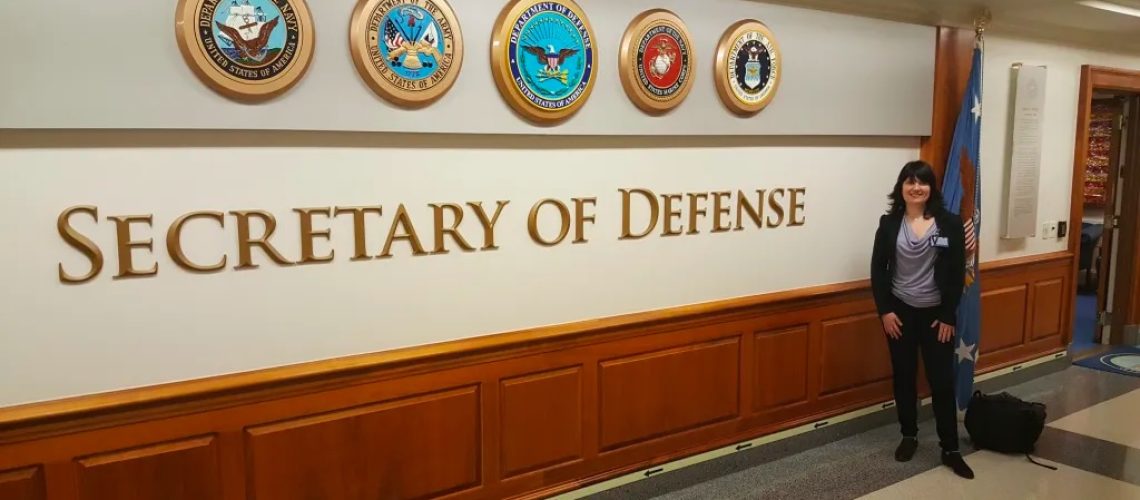
Invited to the Pentagon
While at the event, Briant discussed receiving an invitation to the Pentagon in the US. As a result, she left the event early to travel to this meeting on 10 June 2015 in Washington DC. She was met at the airport by Joel Harding, who by his own account — in a now-deleted blog post — had been “an enlisted soldier on a Special Forces Operational Detachment” before starting a career as a military intelligence officer.