


YouTube Video Here: https://www.youtube.com/embed/8i6Yf8gSVec?feature=oembed&enablejsapi=1
It’s a common stereotype that extraterrestrials may have green skin color, from green Martians to the Egyptian god Osiris, depicted with greenish skin. Ancient Celtic mythology often depicts the Green Man, dating back before the Roman Empire. And, in 12th century England, there is the story of the curious Green Children of Woolpit. This story appears to have been based on real people who may have descendants today.
The story is woven together from accounts by two famous English chroniclers, William of Newburgh, a monk from the Augustinian priory of Newburgh and Ralph of Coggeshall, a monk of the Cistercian abbey. Coggeshall heard the story from a man named Richard de Calne and wrote about it in the Chronicon Anglicanum around 1189. William of Newburgh wrote about it later in Historia rerum Anglicarum, published in 1220.
The story
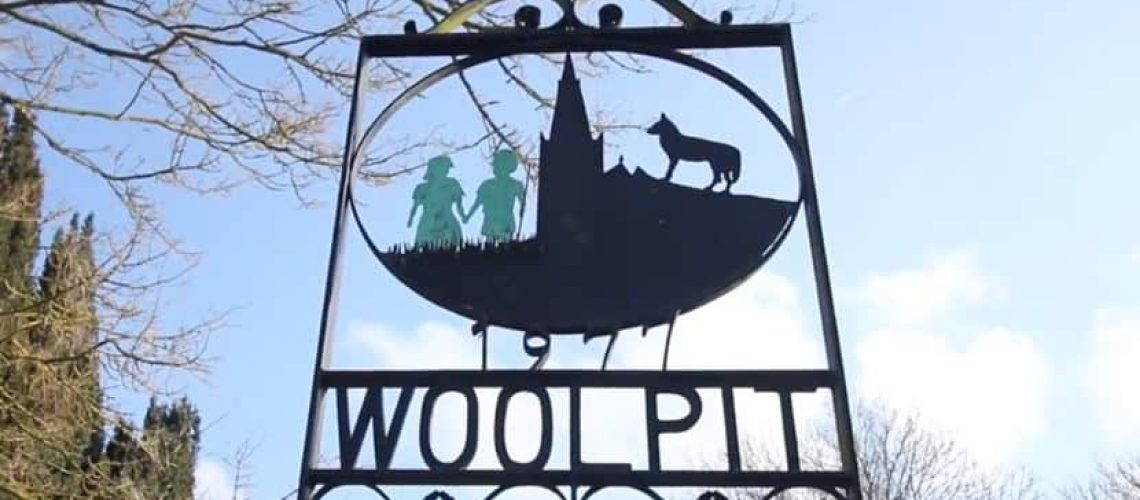
In the mid 12th century in the English county of Suffolk, there was an ancient town called Woolpit. In Old English, the town’s name was wulf-pytt, named for pits dug in the ground to catch roaming wolves in those days. The wolves were killing livestock and terrorizing villagers, but today, this village is famous for two Green Children on its sign.

Around 1150, during the reign of King Stephen, villagers reaping the fields came across two children near a wolf pit who were acting distressed and speaking to each other in an unknown language. A version of the tale says they emerged from the wolf pit, twice as tall as the children and a couple of hundred square feet in area.
Related: An 800-ton monolith from Japan and its similarity to tales of strange otherworldly visitors
The children wore strange clothes unfamiliar to the villagers and spoke an unrecognizable language. And then, of course, their skin was green, a startling sight, but otherwise, they appeared to be normal children.
In Ralph of Coggeshall’s story, the children were taken in by Sir Richard de Calne, the man who told him the story. There, they were offered food but reacted to everything they were given as if they had never seen it before and refused to eat.
It seemed as if the children would starve until they came across something familiar: green beans. In Coggeshall’s story, they find the beans in the garden and gobble them up. In another telling, the children spotted a servant carrying a plate of beans and immediately wanted them. Thereafter, the children were fed beans but slowly weaned over to other food. As their diet changed, the green coloration of their skin began to appear normal.
Sadly, the boy died soon afterward, succumbing to an unknown illness after a period of severe melancholy and lethargy. However, the girl survived and was named Agnes. As she adjusted to her new life, she learned English and could finally answer questions about where she and her brother came from.
A green twilight world
According to Historic UK:
“We are inhabitants of the land of St. Martin, who is regarded with peculiar veneration in the country which gave us birth.”
“We are ignorant [of how we arrived here]; we only remember this, that on a certain day, when we were feeding our father’s flocks in the fields, we heard a great sound, such as we are now accustomed to hear at St. Edmund’s, when the bells are chiming; and whilst listening to the sound in admiration, we became on a sudden, as it were, entranced, and found ourselves among you in the fields where you were reaping.”
“The sun does not rise upon our countrymen; our land is little cheered by its beams; we are contented with that twilight, which, among you, precedes the sun-rise, or follows the sunset. Moreover, a certain luminous country is seen, not far distant from ours, and divided from it by a very considerable river.”
Another version of the story says the children were herding their father’s cattle and heard the bells, then entered into a cave and came out into Woolfpit. They couldn’t find the way back and were discovered by the villagers.
Agnes was baptized and lived and worked for Sir Richard and later was married to the archdeacon of Ely, Richard Barre. The couple had at least one child, thus her descendants may exist today.
According to the East Anglian Daily Times, Agnes was known for her “very wanton and impudent” behavior while in the employ of de Calne and that Richard Barre was a man from King’s Lynn in Norfolk, then a senior ambassador for Henry II.
“It is said that England’s blue blood, even today, has a green tinge through Agnes’ bloodline.”
See more from Today I Found Out:
The source claims that finding the descendants has been tricky, perhaps a carefully-guarded local secret.
“In 1978, local author and folk singer Bob Roberts wrote in A Slice of Suffolk that: ‘I was told there are still people in Woolpit who are ‘descended from the green children’, but nobody would tell me who they are!’”
Who were the Green Children?
To this day, mystery surrounds this story and many people believe these children came from another world or dimension. Is it possible they came through some sort of portal and ended up in the relatively densely populated English town?
Did they really come from a twilight place where everyone had green skin? Why were they so unfamiliar with bright sunlight? Why did they only recognize and accept green beans, refusing other foods? Lastly, if they were ordinary children, why didn’t any relatives ever try to find them?
Now it’s clearly much more fun to imagine the Green Children came from another realm. And, historically, there are similar ancient tales of celestial beings who existed in an underground or hidden world, accessed via portals or “fairy rings” at ancient megalithic structures.
The Tuatha Dé Danann of Ireland were a pre-Celtic Irish tribe of legends that say they were ‘shining beings’ forced to remove themselves to the underground. They may have been driven away by the Celts, who often depicted the Green Man. Today the Tuatha live on in modern fairy tales and epic movies and novels about elves such as Lord of the Rings.
More from Pique:
YouTube Video Here: https://www.youtube.com/watch?v=mzRnOHFKZ2g
Theories and speculation
The more likely explanations, and one that echos a dark fairytale called the “Babes in the Woods” tale, first published in 1595.
According to the Guardian:
“It told the story of a wicked uncle who hires a couple of murderers to kill his orphaned niece and nephew (because, if they die young, he will inherit their estate). The assassins take pity on the children and abandon them in the wood – where they get lost, starve and eventually perish.”
Another theory along the lines of this terrible tale is that the children were poisoned with arsenic by an earl from Norfolk, which tinted their skin green.
An interesting side note: In the 19th century, arsenic and copper were used to dye fabrics green. “Paris green” and “Scheele’s green” were popular colors worn by the social elite in Europe. Arsenic was also found in candy, paper, toys, wallpaper, and medicine before people knew it was deadly toxic. Thus, many in Victorian society died mysteriously. Symptoms could include green hands, yellow nails, and crater-like scars.
If arsenic poisoning was not to blame for the green skin, then “the green sickness” called chlorosis, may be to blame. The condition caused a green complexion and results from iron deficiency. This might explain why Agnes lost her green skin over time as her diet changed.
A third theory is that the Green Children were Flemish victims of persecution during the battle at Fornham in 1173. According to Mental Floss:
“Fornham St. Martin was a nearby village, separated from Woolpit by a river and just a few miles from Bury St. Edmunds, where loud bells often chimed. It’s possible that the children had been orphaned, suffered a poor diet while lost and on their own, and eventually made their way to Woolpit from Fornham St. Martin by following the clanging bells.”
If you consider all the theories, there is still no clear and definite answer. If Agnes and her brother were Flemish children who had lost their parents, why does she make no mention of losing her father? She said she was herding her father’s cows by one account, but doesn’t mention anything out of the ordinary. Why does one account suggest that the green skin coloration was the norm in their place of origin? And lastly, how did the children end up in a pit in the ground after traveling through a cavern?
Abundant questions remain about the Green Children of Woolpit, which makes it a fascinating mystery today.
More from Beyond Science:
YouTube Video Here: https://www.youtube.com/watch?v=lhjpgfyP2Y0
Featured image: Screenshot via YouTube