

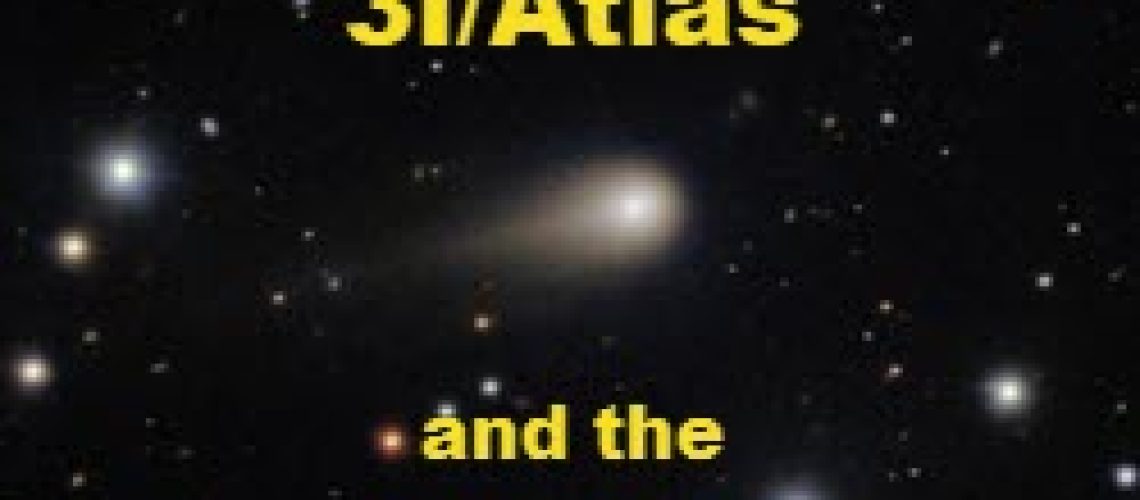

 As of this publication date, we are eight days out from the nearest approach of 3I/Atlas to Earth, and social media is abuzz.
This is to be expected because humanity’s fascination with comets is ancient, emotional, and universal, and 3I/Atlas has, without question, captured human imagination — psychologically, culturally, and scientifically.
Cynics say it’s just a comet, but others openly wonder about the possibility that 3I/ATLAS is more. Much more, and so there is controversy over “intelligent life” or artificial technology associated with the comet, and what that means for humanity.
The man who first sparked this controversy is Harvard astrophysicist Avi Loeb, and major media outlets widely covered his views. Loeb maintains that 3I/ATLAS might not be a usual comet and could even be alien technology or engineered in some way.
Critics emphasize that there was no evidence for his interpretation, but let’s frame this another way.
 In our article Signs 108 – The Bitch Is Back, we posted a December 2025 image of two suns in the sky as observed by a flight of Bell UH-1 helicopters.
This is what GROK had to say about it, and mind you, Grok is primarily based on the Google Search Index, which is rife with deep state propaganda:
“GROK: Recent online discussions link similar “two suns” visuals to comets like 3I/ATLAS or religious prophecies, but experts attribute them to optical illusions like sun dogs or lens artifacts, with no verified global event reported in early December 2025.”
The point here is that critics and naysayers are typically biased and will resort to pulling straws in order to dismiss any view inconsistent with their beliefs and agendas.
With this in mind, let’s take a deep dive into 3I/ATLAS regarding its observation timeline and controversies. Plus, what are the contact possibilities if Harvard astrophysicist Avi Loeb’s suggestion that 3I/ATLAS might not be a usual comet and that it could even be alien technology or engineered in some way?
Timeline and Observation
Comets strike something profound in us because they combine beauty, mystery, danger, and meaning in ways few celestial objects do. This is because comets appear suddenly and break the rules of the sky.
For example, the sun rises and sets, so we use sundials to tell time accurately. Hence, lunar calendars such as the Hebrew calendar are built around agricultural seasons, and in cycles in ancient Israel, festivals were intentionally placed to line up with planting, harvesting, and first-fruits
Then there are the stars that remain, which remain fixed in the sky. For example, the North Star is Polaris, the star that sits almost exactly above Earth’s North Celestial Pole. It shows true north and stays nearly fixed in the same spot all night, and every other star appears to move around it.
3I/ATLAS certainly breaks the rules, and its actual timeline begins in late June of 2025, although it was not officially discovered until the following month. Below are the significant points on the observation timeline.

- JULY 1, 2025 — DISCOVERY: First observed by the ATLAS survey telescope in Río Hurtado, Chile. The observation was reported to the Minor Planet Center the same day.
- LATE JUNE 2025 — PRECOVERY IMAGES: After the discovery, astronomers identified earlier images (“precovery data”) showing the object in late June.
- JULY 2025 — ORBIT CALCULATED: Follow-up measurements revealed a strongly hyperbolic orbit, confirming it was an interstellar object, only the third ever identified.
- OCTOBER 29, 2025 — PERIHELION: 3I/ATLAS reached perihelion, its closest point to the Sun.
- NOVEMBER 2025 — BRIGHTEST APPEARANCE FOR TELESCOPES: After emerging from solar glare post-perihelion, the comet reached about magnitude 9–10 — its brightest for ground-based observers with moderate telescopes.
- DECEMBER 2025 — CLOSEST APPROACH TO EARTH: 3I/ATLAS made its closest approach to Earth at roughly 7 AU (still far beyond Jupiter’s orbit), but fully observable in the night sky again.
- JANUARY 2026 ONWARD — FADING: Continued moving outward from the Sun; brightness progressively faded (mag 12?13+), becoming a target primarily for large observatories.
 |
|
Radio Free Earth: The Complete Beginner’s Guide to Survival Communications |
|
Signed editions are personalized and include instant media downloads. Marshall will note your ship-to location and let you know if you’re well situated or suggest an alternative location. |
The one question everyone asks is: will we be able to view 3I/ATLAS with the naked eye at any time, like other major comets? The answer is no, because 3I/ATLAS is too faint and never gets anywhere near bright enough; however, it is bright enough for assisted viewing, so let’s take a brief look at the issue of magnitude and observation.
Viewing Magnitude
 In astronomy, magnitude is a unitless measure of the brightness of an object in a defined passband, often in the visible or infrared spectrum, but sometimes across all wavelengths. To help visualize this astronomical magnitude scale in terms of temperature, we need to think in reverse.
With temperature, freezing is the point at which a liquid turns into a solid, specifically when the temperature falls below 0 °C (32 °F) for water. Below that, things get colder; ergo, those who live in colder climates, such as those with negative temperatures, such as -0.6 °C (20 °F), know to dress warm and let a faucet drip to keep the water pipes in the house from freezing.
With the astronomical magnitude scale, the lower the number, the more visible the night sky object. For example:
- Magnitude -26.74: Our Sun
- Magnitude -12.9: Full Moon at Supermoon
- Magnitude -3: The International Space Station as Seen Over England
- Magnitude -1.46: Sirius (The brightest star in the sky.)
- Magnitude 0.0: The Bright star Vega in the Constellation Lyra
- Magnitude 6.0: Stars too faint to be seen with the naked eye.
- Magnitude 6.5: Faintest stars visible to the naked eye with a good viewing sky in a dark rural location.
- Magnitude ~9.0: 3I/ATLAS Near Perihelion in Late October 2025
- Magnitude ~11.0: 3I/ATLAS Mid-November 2025
- Magnitude ~12.0: 3I/ATLAS Mid-December 2025
- Magnitude ~13.0: 3I/ATLAS Mid-January 2026
For viewing 3I/ATLAS, what is possible? For casual assisted viewing, most people use binoculars, which, in general, are good up to Magnitude 9 when the sky is clear in a dark rural location. However, viewing 3I/ATLAS now, until it fades in late January 2026, is a non-starter. However, it is possible with one of the two most popular telescope types for amateur astronomers. The following values are approximate.
 Dobsonian Reflectors: The most affordable type; the view from a reflector is always flipped upside down due to the nature of the mirrors.
- A small 4.5″ – 8″ Dobsonian Reflector telescope is ideal for viewing planets, but is unsuitable for viewing 3I/ATLAS.
- A medium 10″ – 16″Dobsonian Reflector telescope will work through mid-January 2026 before 3I/ATLAS fades away.
 Schmidt–Cassegrain Telescopes (SCTs): Considerably more expensive than Dobsonian Reflectors, they do not flip the image as a Dobsonian Reflector does. They are better suited to viewing objects like 3I/ATLAS thanks to computer automation with Motorized GoTo tracking.
- A 10”–12” SCT has a good chance of 3I/ATLAS detection.
- A 14″+ automated SCT will detect and track 3I/ATLAS detection until it fades.
How much do these telescopes cost? A 10” Dobsonian Reflector will cost approximately $1,000. A comparable SCT will be at least 3X that much. If you want to become a serious amateur astronomer, be prepared for the cost commitment.
If you are a casual observer, talk to your friends who are amateur astronomers to see if they will be viewing it, and ask them if you can join them. Or, contact a local astronomy club to see if they will be observing 3I/ATLAS and if they will let you tag along for the view.
That said, let’s see how the controversy over this object began.
Avi Loeb and the 3i/Atlas Controversy
We’ve heard about the alien mothership predictions and that 3i/Atlas will bring us an age of enlightenment, or conversely, times up for humanity. There is no practical way to verify these claims independently, and since Yowusa.com was founded in 1999, we’ve come to file such claims under the “usual suspects” heading because they keep playing and replaying time and again.
 For this reason, we choose to stick to the science, and at the heart of the 3i/Atlas controversy is Avi Loeb, a prominent American astrophysicist.
Loeb is a Harvard University professor with leadership roles in astrophysics and theoretical astronomy and the founder of the Galileo Project, a research initiative that seeks to explore evidence for technosignatures — signs of extraterrestrial technology — in astronomical data.
An interview aired on December 9, 2025, he holds NASA and other space agencies to task for not publishing any scientific papers to back up their claims. The relevant parts are featured in this 3I/ATLAS report by Cristina Gomez. It is excellent and worth watching all the way through.
YouTube, December 11, 2025
Cristina Gomez, UFONews.co
3I/ATLAS SHOCKS GLOBAL AGENCIES INTO ACTIONCristina Gomez discusses the very latest updates about interstellar visitor 3I/ATLAS and how this object continues to demonstrate a possible artificial nature, as well as the first-ever X-ray detection from interstellar object 3I/ATLAS by Japan’s XRISM satellite, coordinated global space defense drills by ESA, NASA, and the US Space Force, and Avi Loeb’s swarm theory as the mysterious visitor approaches Earth on December 19, 2025.
 |
|
Win-Win Survival Handbook: All-Hazards Safety and Future Space Colonization |
|
Signed editions are personalized and include instant media downloads. Marshall will note your ship-to location and let you know if you’re well situated or suggest an alternative location. |
I want to give a shout-out to Cindy Hasse, a Yowusa.com supporter, for this link, which is one of many she has sent me for the last few days. Thank you, Cindy, because at present I’m working on my next book, Mars Beta: A New Time of Men. It is why I have not been posting more frequently. However, Cindy’s persistent emails convinced me it was time to research Avi Loeb and the crux of this controversy.
About Avi Loeb
Avi Loeb has written popular books on the search for extraterrestrial life and has pushed for considering unconventional hypotheses about unusual space objects. What I like most about Avi is that he emphasizes exploring hypotheses rather than dismissing them out of hand, and has pointed to several features he considers unusual and do not fit simple comet models.
- Lightcurve “heartbeat”-like signal: He describes a periodic pulse in how the comet brightens and dims, which he argues is not typical for comets. The Times of India.
- Odd tail and anti-tail behaviors: The orientation of the dust tails and seeming “flips” in tail direction, which he argues may not fit simple solar radiation pressure models. The Economic Times
- Multiple jets or structural features: He’s noted complex jets or coma structure that he argues could resemble controlled outflows rather than ordinary cometary outgassing. VICE
Loeb sometimes highlights statistical features — like its orbital alignment close to the ecliptic — as unlikely for a random interstellar comet and argues that scientists should keep an open mind about the possibility that an interstellar object could be artificial or engineered, just as humanity has sent spacecraft into space.
But all this leaves me wondering. Not about disclosures by benign aliens who want to help us evolve because humanity has never been alone and never will be. No, it’s about the future after a full disclosure of humanity’s history. Or should we say, ‘past histories?’
The Future of Humanity
The most interesting aspect of 3I/ATLAS is all the speculation and how I see people reacting to it. A strange mix of denial, eager anticipation, and a twinge of dread, leaving us to ponder all this in a very personal way.
In the late 1980s, I was a science feature field producer for CNN, back when the network was doing real news, and at that time, the holy grail of the science department was Big Bang Theory.
The Big Bang Theory wasn’t a single project—it developed over about 100 years through many scientists, observatories, and experiments around the world. It included hundreds of universities, national labs, telescopes, and space missions. So, when did it all begin?
It began in 1927, when Georges Lemaître proposed that the universe is expanding from a “primeval atom.” Then, in 1929, Edwin Hubble discovered galaxies moving away from us, giving the first strong evidence for expansion. The work continues to this day with research in dark matter, dark energy, and inflation.
The Big Bang question for me as a CNN science producer was simple. Will the universe continue to expand as Hubble observed in 1929, and will our universe continue to spread out like ripples in a pond? Or, would gravity, the strongest in the universe, ultimately take hold and compress everything back into the “primeval atom” described by Lemaître?
In the 1980s, spending on Big Bang research was so massive that it literally sucked the funding life out of other science and astronomy projects, such as building an asteroid defense shield for Earth, and over the last 30–40 years. Roughly $11–12 billion has been spent, mostly by NASA in the U.S., ESA in Europe, and global research collaborations.
Along the way, science finally answered the question I was tasked to report back in the 1980s. It was determined with 99% certainty that the universe will continue to expand and spread out and that gravity will not collapse everything back into Lemaître’s “primeval atom.”
For $12 billion in funding, a solid 100% would be nice, because that remaining 1% of doubt leaves us listening to Peggy Lee singing “Is That All There Is.”
So there I was, listening to “Is That All There Is” and thinking about all those billions of dollars, until years later when I initiated the publishing project for The Kolbrin Bible: 21st Century Master Edition. What started it for me was Yowusa.com co-founder Steve Russsel of Australia, who found that this 3,600 wisdom text contains outstanding accounts of previous Planet X flybys.
Initially, I was skeptical, but Steve pressed me to read it, and by the second page, my doubt was gone because, as ancient Egyptian scribes penned the first seven books, as Hebrew scribes were also writing the Five Books of Moses.
In this account, I finally had closure on that nagging one percent that 14 billion dollars of research funding could not resolve, and here it is.
The Kolbrin Bible: 21st Century Master Edition
Book of Creation
Chapter One – CreationCRT:1:5 He who preceded all existed alone in His strange abode of uncreated light, which remains ever unextinguishable, and no understandable eye can ever behold it. The pulsating draughts of the eternal life light in His keeping were not yet loosed. He knew Himself alone; He was uncontrasted, unable to manifest in nothingness, for all within His Being was unexpressed potential.
CRT:1:6 The Great Circles of Eternity were yet to be spun out, to be thrown forth as the endless ages of existence in substance. They were to begin with God and return to Him completed in infinite variety and expression.
CRT:1:7 Earth was not yet in existence; there were no winds with the sky above them; high mountains were not raised, nor was the great river in its place. All was formless, without movement, calm, silent, void and dark. No name had been named, and no destinies fore-shadowed.
When I read CRT:1:6 for the first time, it staggered me and left me asking one poignant question. How is it that, 3,600 years ago, the ancient Egyptians had already had the answer to the question with 100% certainty that our galaxy would continually and indefinitely expand?
It was in the verse, “They were to begin with God and return to Him completed in infinite variety and expression.”
There is no possible way that Lemaître’s “primeval atom” could ever be the ultimate fate in a universe described by the ancient Egyptians, say, with an infinite outcome in variety and expression.
Now, on one hand, I could have said that’s a wrap, that nagging 1% is solved, but it was not to be, because then I found myself with an even bigger question.
If the ancient Egyptians knew the answer to the Big Bang theory over 3,600 years ago, how much of humanity’s history has been hidden from us, or more to the point, how many histories?
As I contemplate the 3I/ATLAS and the controversy surrounding Avi Loeb’s hypothesis, the central question I’m asking is not whether we’re alone in the universe. We never have been, nor will humanity ever be.
Will There Be Another Reboot of Humanity?
The question is, how many times has our species been rebooted? Think of it this way. Humanity is a young species, and we live on a dying planet with awful natural disasters that kill us by the millions. While we see ourselves as a predator species, we’re not the apex predators of our planet, as other species kill us with great ease. Then again, throughout time, not one generation of humans has not made war upon another.
 |
|
The Kolbrin Bible: 21st Century Master Edition |
|
Signed editions are personalized and include instant media downloads. Marshall will note your ship-to location and let you know if you’re well situated or suggest an alternative location. |
For an advanced alien species, could we not present a terrible threat, with nuclear weapons that could end all life on our planet, and now we are reaching for the stars?
SpaceX is building the most enormous reusable rockets in history, and they can parallel park. Like the NASA orbiters, they depend on ceramic tile for their re-entry heat shields, but with one crucial difference.

During the NASA Space Shuttle program, the agency could manufacture only an average of 13 ceramic heat tiles per day for its fleet of reusable orbiters. There is no threat there, but what about today?
Today, SpaceX has a manufacturing facility capable of manufacturing 7,000 ceramic heat tiles a day for its Starship heavy lifters, so if you are thinking that going to Mars is still science fiction, it’s not. We’re going, and the SpaceX Starship heavy lifters are designed to carry 100 people. The current first planned manned mission will use two heavy lifters to transport 200 colonists and scientists to Mars within the decade, and that’s only the beginning.
Imagine you are an ancient alien race and you see a young, primitive, nuclear-armed species coming your way. One with a continuous history of rapid technological development and war. How would you react? Would you take a wait-and-see attitude for our species, or err on the side of safety, or defeat us before we become an interstellar threat?
This makes me think about a fringe theory that has circulated online in the last decade, about an American global advanced civilization named.

Called Tartaria, it was an international, highly advanced civilization with giant architecture, free energy, and advanced technology. Yet, it was erased from history with dismissive explanations that tie to “mud flood” myths and the like.
It begs the question: did alien races destroy Tartaria out of a sense of precaution and safety, and, if so, how many times has humanity reached this point only to be destroyed and then rebooted?
These are the 3I/ATLAS questions on my mind, and they lead me to a single conclusion. Whatever the disclosures may be, will they include our past histories and species reboots so that we can reach out to life elsewhere in the universe in peace? Will other races finally accept us and say, “where the humans go, green goes,” or will there be yet another reboot?
Whatever those disclosures are, I hope that they lead us to a point in our evolution where we are finally in it for the species. This is because while we must take people one at a time, if we cannot love our own species, who in the universe will?
For me, this is the ultimate existential 3I/ATLAS disclosure question of all, and I await the answer with hope and a prayer for the future.